
Background
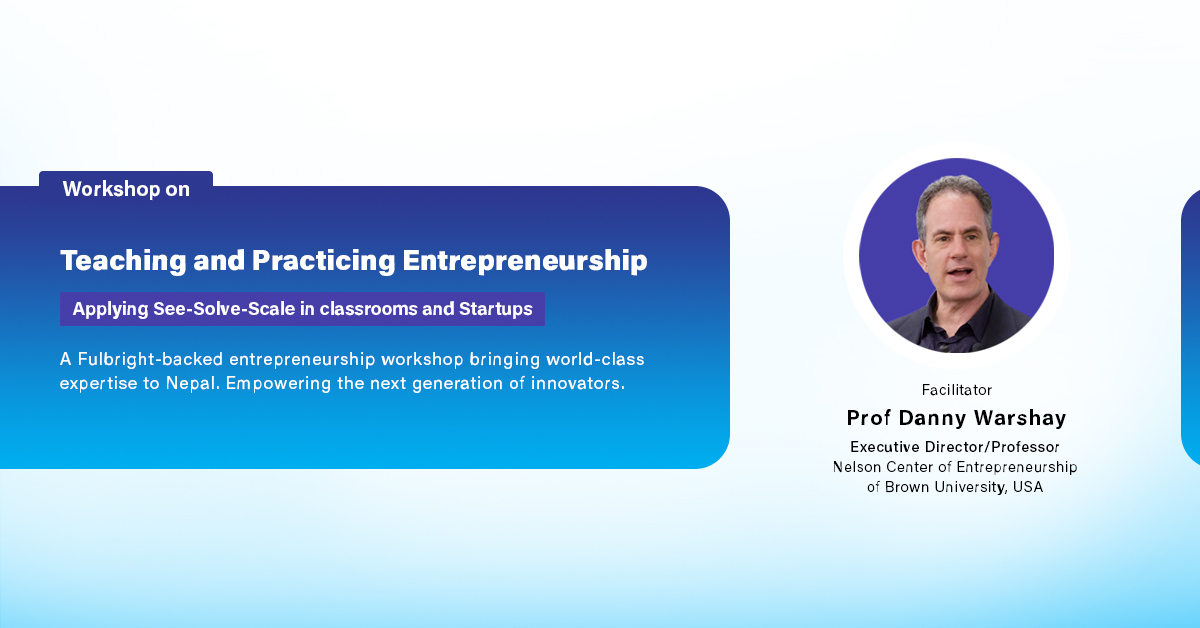
The British College (TBC), Nepal, is proud to announce a specialised workshop on entrepreneurship, delivered in collaboration with renowned entrepreneurship expert, Professor Danny Warshay, as part of the prestigious Fulbright Programme Specialist Project. This initiative reflects TBC’s strong commitment to strengthening entrepreneurship education in Nepal and fostering innovation through world-class international expertise.
Course Important Details
Title: Teaching and Practicing Entrepreneurship: Applying See–Solve–Scale in Classrooms and Startups
Expected Start Date: January 06/Tuesday, 2026
Expected End Date: January 15/Thursday, 2026
Schedule: Every day for 3 hours (30 min break) per session from Jan 06 to Jan 15 (Saturday/Sunday will be off)
Session Time: 7:00 AM to 10:00 AM
Venue: The British College, Conference Hall, Thapathali, Tradetower, Kathmandu, Nepal
Registration Cost: Free
Workshop Description
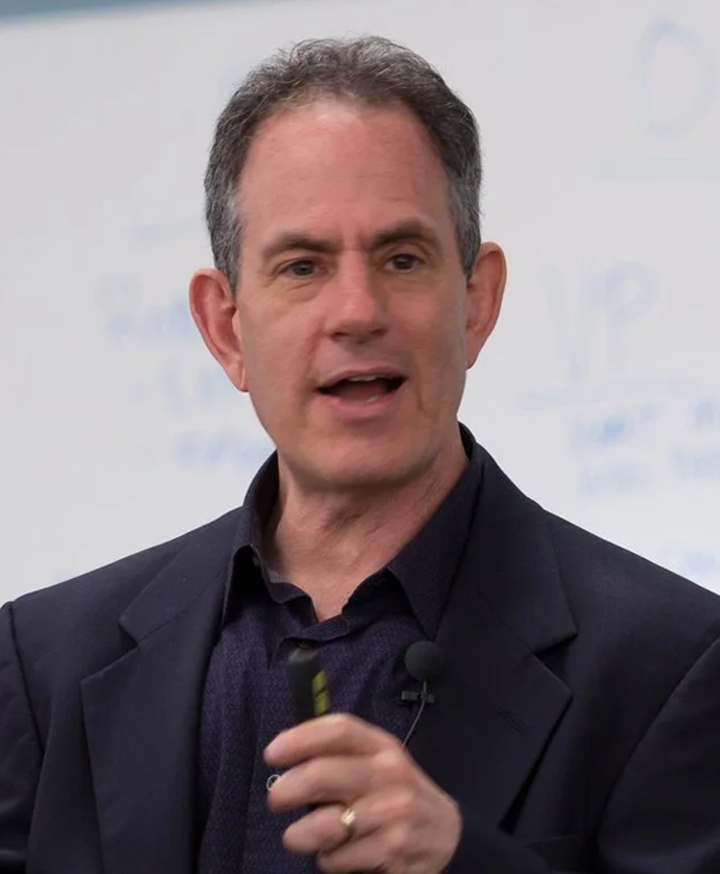
TBC is honoured to offer a specialized, interactive Fulbright-supported workshop, led by Professor Danny Warshay from Brown University, that brings together faculty members, entrepreneurs, and advanced students to explore a practical and human-centered approach to entrepreneurship. Using the See–Solve–Scale framework, participants will learn how to identify real customer needs, design meaningful solutions, and develop strategies to scale ideas into sustainable ventures.
Through hands-on exercises, mixed-group collaboration, and real-time feedback, participants will experience the full entrepreneurial problem-solving process—and understand how to apply it both in teaching and in practice. Whether you are an educator designing entrepreneurship modules, a founder running a venture, or a student preparing to launch your idea, this workshop equips you with the tools to transform insights into impactful action.
Learning Objectives
Our primary objective is for all three groups of participants—faculty members, entrepreneurs and students who are aspiring entrepreneurs—to learn to use and teach the fundamentals of the See Solve Scale process as a new approach to identifying and solving problems, eventually on a big scale.
Learning Objectives: By the end of the workshop, participants will be able to:
- Understand and apply the See Solve Scale framework
- Grasp the core concepts of SEE, SOLVE, and SCALE and use them to analyse entrepreneurial opportunities.
- Develop the ability to identify real, unmet customer needs (SEE)
- Use observation, bottom-up research, and empathy-based methods to define strong problem statements.
- Generate and evaluate solution ideas based on real needs (SOLVE)
- Apply creative mindsets and techniques to develop feasible ideas and validate them with early feedback.
- Create strategies for testing, launching, and scaling new ideas (SCALE)
- Create simple MVPs, explore early traction pathways, and understand principles of sustainable scaling.
- Collaborate across roles—educator, entrepreneur, and student
- Work in interdisciplinary teams—educators, entrepreneurs, and students—to co-create solutions.
- Integrate See Solve Scale into classroom teaching or entrepreneurial practice
- Apply the framework to course design, mentoring, or developing new ventures.
Target Participants
● Faculty Member, with experience teaching the Entrepreneurship module
● Entrepreneur, with a minimum of 3–4 years of experience running their own business
● Student (UG/PG), with experience in a startup, family business, or with strong entrepreneurial aspirations
● Open Seats: 20% of the seats are reserved for TBC students and faculty members
● Batch Size: 30-40 participants to ensure high interaction.
Methodology
Entrepreneurship is a structured process for problem solving without regard to the resources currently controlled. It encompasses three primary activities: 1) See: Finding and validating an unmet need 2) Solve: Developing a small-scale value proposition and 3) Scale: Creating a sustainability model to have long-term impact at scale. This is a process that applies to a wide range of contexts including established organizations looking to innovate. Our See Solve Scale workshops will present elements of this entrepreneurial process through Harvard Business School case studies and interactive training sessions that illustrate essential elements of a learnable and teachable framework and highlight practical approaches to entrepreneurial success.
The format of these workshops will be interactive, including a couple of Harvard Business School case studies that will expose participants to the rhythm and demands of a Socratic case study teaching and learning approach. And it will challenge you to apply your own experience and what you learn through your own analyses of the cases and supplementary readings in workshop discussions. It is critical that you read and analyze the cases and supplementary readings before you come to the workshop sessions, and come ready to be called on to start and participate in the discussion. In short, this Socratic case study approach will present topics on entrepreneurship in a context that will simulate the real-life entrepreneurial contexts. And in particular, we will look to draw explicitly on some of your own experience.
Through these workshops, we intend for participants to focus on specific demands of the entrepreneurial process, and to develop additional confidence and acquire tools needed to approach your challenges more entrepreneurially. For teachers, we will discuss these pedagogical approaches so that you will feel more confident teaching entrepreneurship.
These intensive workshops will be rigorous and will reap significant rewards for their commitment and investment.
Workshop Schedule
Time: 7:00 am to 10:00 am
| # | Date | Workshop Title |
| Pre-reading | ||
| 1. | Jan 6/Tuesday | See Solve Scale (Framework) |
| 2. | Jan 7/Wednesday | Benefits of Scarce Resources |
| 3. | Jan 8/Thursday | Entrepreneurship in Established Organizations |
| 4. | Jan 9/Friday | Bottom-Up Research: Finding and Validating Unmet Needs |
| 5. | Jan 12/Monday | Solving Problems: Mindsets |
| 6. | Jan 13/Tuesday | Solving Problems: Techniques |
| 7. | Jan 14/Wednesday | Scaling: Thinking Big |
| 8. | Jan 15/Thursday | Day of Reflection |
IMPORTANT: Please note that you need to come to the workshops having read See Solve Scale ahead of time and analyzed the case studies and supplemental readings for each session, ready for me to call on you to participate.
Contact
Workshop Lead: Sunita Basnet – Sr Faculty/Head of Sustainability, The British College
✉ s.basnet@thebritishcollege.edu.np